
Make your agent challenge its own findings
Cloudflare separates security hunters from verifiers, ThinkRail gives agents separate workspaces, and Lemo-Opuscar makes films in code.
22-29 October 2026. Edition 6. Star counts come from LLMRepos daily snapshots; GitHub counts may have changed.
A confident security report can give you a long to-do list. The useful question is which findings survive someone trying to disprove them.
My pick is Cloudflare's security-audit skill. It assigns discovery and verification to different agents, and keeps unresolved leads separate from confirmed findings. Try it on a small repository you own, then trace one finding back to the code. A second opinion is more useful when it can say no.
Elsewhere: a workbench for keeping coding sessions apart, a gateway for comparing models, films built from code, and an inference engine small enough to study.
Moving fastest
JetBrains/thinkrail
Two agents, one checkout, and suddenly nobody knows whose change that was. ThinkRail wraps the pi coding agent in an IDE with separate Git worktrees, diff review and project specs stored beside the code. It gained 4,424 stars (+451.9%) to reach 5,403.
Give two small fixes their own workspaces. Review each diff, then check whether the spec files preserve enough context to resume the work tomorrow. That's a useful test if your current workflow involves reconstructing yesterday's chat.
The README lists Git and a connected model provider as requirements. Worktree isolation separates files; it does not make inference local. The project is a JetBrains incubator, and its advertised full extension support is still future work.
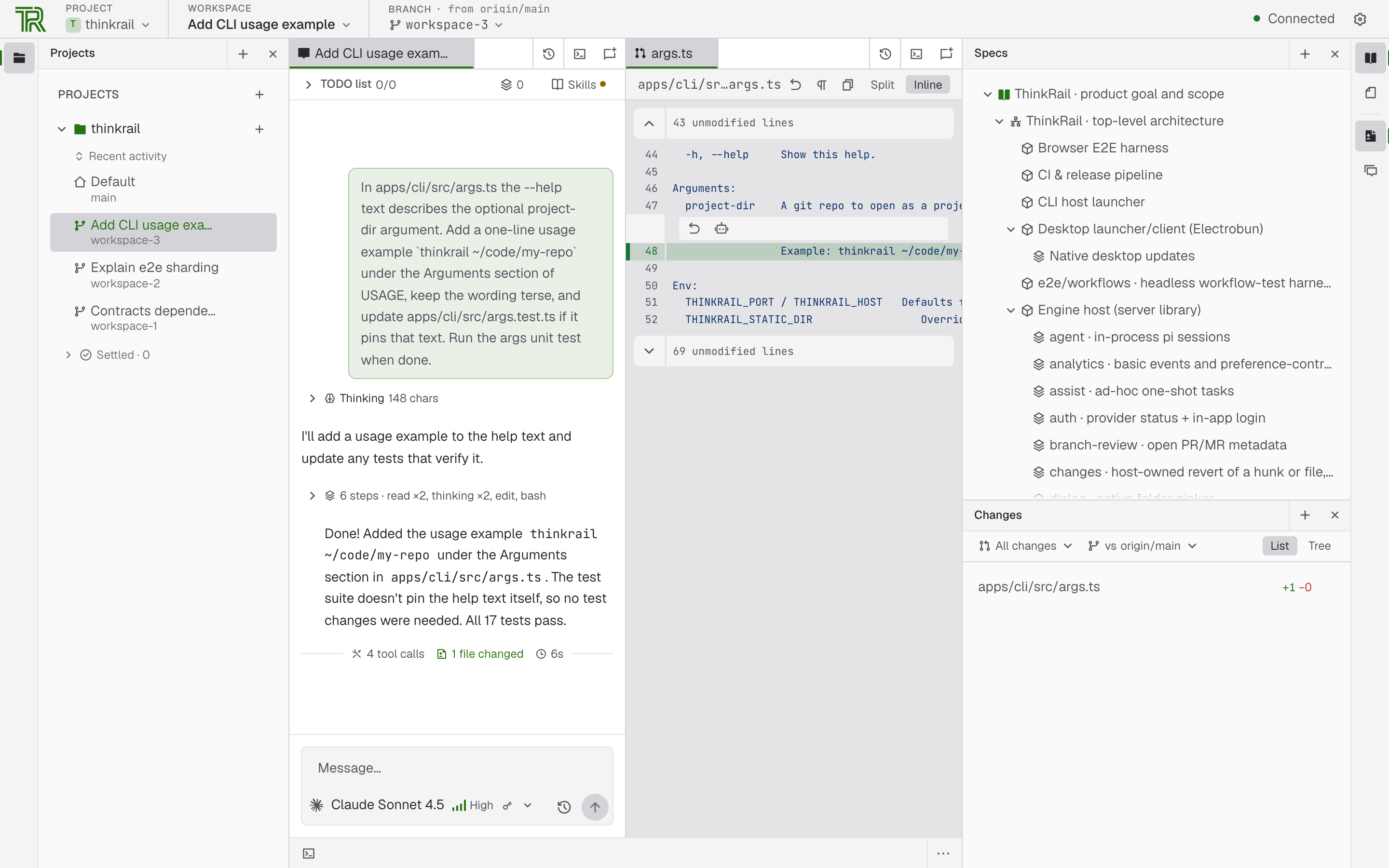
Screenshot: ThinkRail README.
experientiallabs/experiential
Changing a model is easy. Finding out whether the cheaper one still does the job takes evidence. Experiential provides an OpenAI-compatible gateway for hosted, bring-your-own-key and local models, with spending controls and tools to fit a router from agent traces. It gained 3,520 stars (+34.6%) to reach 13,699, tracked under its earlier world-model-harness name.
For a first comparison, route one non-sensitive workflow through it and record cost alongside whether the task succeeded. Keep a fixed-model baseline before trying the trace-based optimisation. Lower spend is only useful if the work still gets done.
Start with the local gateway instructions. The separate desktop capture feature requires macOS, Python 3.13+, an extension and certificate approval; the maintainers call it experimental and are investigating network reliability. A local gateway can still call remote providers, and hosted trace uploads are a separate data-sharing decision.
cloudflare/security-audit-skill
The interesting output here includes the findings the agent rejected. Cloudflare's skill maps a repository's trust boundaries, assigns hunting work, then gives each candidate to a fresh verifier. It added 14,753 stars (+39.6%) to reach 51,981, crossing into our largest band.
Ask for an audit of a small codebase you know. Read the coverage ledger alongside the findings: what did the agents inspect, what did they reject, and what remains unresolved? The structured records distinguish all three. A clean-looking report without coverage is a very tidy unknown.
The requirements include parallel subagents, Node.js and an OS-enforced sandbox for executing target code. Without the required isolation, runtime-dependent leads stay unvalidated. This is the single-repository starting point behind Cloudflare's larger harness; it does not establish that your app is secure.
New arrival
lemomo-ai/lemo-opuscar
Your coding agent can make the launch film too. Lemo-Opuscar supplies film styles and a production workflow that renders coded scenes frame by frame, then combines narration, music and subtitles. Created 26 September, it reached 9,192 stars by 29 October, up 4,180 over the week.
Try a 20-second explanation of one product feature. Pick a style, request the storyboard first, and check the words and pacing before the full render. The source remains editable, so changing a label needn't mean generating a whole new shot.
The setup guide budgets 30-60 minutes and substantial tokens per film, with Node 20+, FFmpeg 7+ and Python 3.11+ required. Styles are tuned for Claude Opus 5.5; results with other models may differ. Demo footage has separate licensing and some excluded voice tracks, so check credits before reusing it.

Unmodified still: LemoLab, Lemo-Opuscar, CC BY 4.0. A custom style derived from its Swiss Motion Graphics example.
Quiet but still loved
GeeeekExplorer/nano-vllm
If prefix caching is still a box on your architecture diagram, Nano-vLLM offers a smaller place to see how it works. This compact vLLM-style inference engine covers scheduling, caching and GPU execution. It had 16,205 stars and 186 days since the last commit in the 29 October snapshot, gaining 150 stars during the week.
Start by following a request from LLMEngine into the scheduler and model runner. If you have a suitable NVIDIA GPU, try the small Qwen example and inspect what happens when prompts share a prefix. Reading the path is useful even before running it.
The README's speed comparison is a maintainer benchmark on one laptop GPU and model. The code uses CUDA; its package requires Python 3.10-3.12. Treat it as a study project with a dated maintenance gap, and check compatibility before making it part of a serving stack.
What's one agent finding you had to disprove yourself? If this reached your inbox, reply with the example and what caught it.
Selection: three risers from distinct end-date star bands (500-9,999; 10,000-49,999; 50,000+), one project created within 90 days and one with at least 5,000 stars and 180 days without a commit. Growth compares paired observations from completed imports on 22 and 29 October; risers need at least 500 stars at both dates. Previous archive features, duplicate identities and permanent editorial exclusions are removed. Editorial choices weigh practical value alongside growth. Stars measure attention, not quality. Read this edition online.
LLMRepos tracks open-source LLM and agent repositories using daily GitHub snapshots.
Get the next edition
Five open-source AI repos worth watching, every Tuesday.
Free weekly digest. Double opt-in, unsubscribe anytime.